- Register for the Alzheimer's Walk on Saturday, November 14, 2026!
- Why VNS Health Team Members Are Walking in Support of People With Dementia!
- Caring for People With Alzheimer’s Disease: A Guide for Home Health Aides
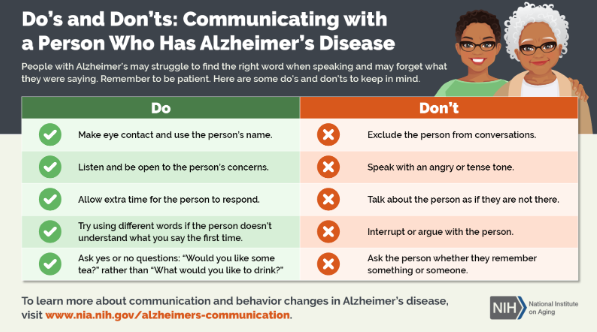
- Do's and Don'ts: Communicating with a Person Who Has Alzheimer's Disease
- References
- Questions?
Register for the Alzheimer's Walk on Saturday, November 14, 2026!
Join your Personal Care Home Health Aide colleagues as well as team members from across VNS Health, plus their family members and friends, on Saturday, November 14, as we come together to walk in Central Park in the Alzheimer’s Association’s Walk to End Alzheimer’s.
Details:
- When: Saturday, November 14
- Where: Meet in Central Park – Near Naumburg Bandshell (Mid-Park at 71st Street in Manhattan)
- Time:
- Check in: 10:00 AM
- Opening Ceremony: 11:15 a.m.
- Walk Starts: 11:30 a.m.
- Length: 2 miles
There is no fundraising requirement to participate. Just register, invite your family and friends to join you, and come walk with us! Registered VNS Health walkers will also receive a special-edition VNS Health Walk T-shirt.
This cause is closely connected to the work we do every day. Cognitive impairment and memory loss affect an estimated 30–40% of the clients, patients, and health plan members we serve. By walking together, we can show our support for people living with Alzheimer’s and other dementias, their caregivers and families—while demonstrating the strength and spirit of One VNS Health.
Please note that you are not required to attend this walk and your participation is completely voluntary.
Here’s the link again to register! Just click on this link to register!
Whether this cause touches your work, your family or someone you care about, we hope you’ll join us.
Walk with Purpose. Walk as One.

Why VNS Health Team Members Are Walking in Support of People With Dementia!
Caring for People With Alzheimer’s Disease: A Guide for Home Health Aides
Alzheimer’s disease affects memory, thinking, communication, and everyday activities. Home health aides (HHAs) can help by providing calm, respectful care that supports each person’s dignity, comfort, and remaining abilities. Every person is different, so learn about the person, their routines, and preferences by asking family members or the person, themself, as the person may still have the faculties to respond and what they say should not be ignored, even if they respond incorrectly. Examples: “What did they do for work in the past?”; “What are their favorite hobbies?”; “Who are the persons they were close to?”
Communicate with patience. Approach the person from the front, introduce yourself, and speak at eye level using a calm tone. Allow time for a response. If the person does not understand, repeat using the same words. Offer simple choices, such as “Would you like the blue shirt or the white shirt?” Avoid testing memory, arguing, or talking about the person as though they are not present.
Use validation: acknowledge the feeling. Validation means recognizing the person’s emotions, even when their understanding of events differs from yours. A person with Alzheimer’s may be in the past. Meet them where they are; do not try to correct them with reality. If someone says, “You stole my purse,” try, “I see you’re worried about your purse. Let’s look for it together.” Take concerns seriously and follow agency procedures if theft or mistreatment is suspected.
Respond kindly to repetition. A person may repeat questions or stories because they do not remember asking or telling them. Repetition can also express anxiety or a need for reassurance. Avoid saying, “I already told you.” Answer briefly and calmly, even if you must repeat yourself, and then use distraction. If someone repeatedly asks, “When is my daughter coming?” say, “She’s coming at three. I’ll stay with you until then,” if that is accurate. A large written reminder may help if the person can still read and understand it. Then offer something meaningful as a distraction, such as looking at photographs or folding towels.
Look for the need behind challenging behavior. Pacing, yelling, or resisting care may communicate pain, fear, hunger, thirst, fatigue, toileting needs, or overstimulation. Ask yourself: What happened just before this? Does the person have a need that is not met? Are there a lot of things going on in the environment? Lower noise, reduce demands, and speak gently. Try familiar music, a favorite TV show, or games. If someone pushes your hand away during bathing, pause, respect their privacy, and check if they are cold, uncomfortable, or frightened. Explain one step at a time and try again later when safe. Do not force care; report repeated refusals or unmet care needs to the supervising nurse.
Observe, document, and report. Sudden confusion or a rapid change in behavior is not automatically Alzheimer’s progression. Illness, pain, infection or medication effects may be involved. Report promptly to the supervisor. Record specific observations—for example, “Shouted and pushed the washcloth away when bathing began”—along with what happened beforehand and which responses helped. Practice self care.

Do's and Don'ts: Communicating with a Person Who Has Alzheimer's Disease
References
- Alzheimer’s Association. (n.d.). Repetition.
- Alzheimer’s Association. (n.d.). Suspicion & delusions.
- Alzheimer’s Association. (n.d.). Anxiety & agitation.
- National Institute on Aging. (n.d.). Communicating with someone who has Alzheimer’s disease.
- National Institute on Aging. (n.d.). Coping with agitation, aggression, and sundowning in Alzheimer’s disease.
Questions?
Thank you for your interest in walking with us! We look forward to seeing you on November 14!
If you have any questions about the Walk, please reach out to Amanda Weiner.
If you have any questions about brain health, in general, please reach out to Mary-Ellen Betterton.